

Virginia Tech Torgerson Bridge - image courtesy of https://commons.wikimedia.org/wiki/user:MatthewMcClure
Virginia Tech doesn't only decide whether to admit your student. It decides whether to admit your student to the major listed on the application.
Which is why, with Early Action due November 15, several of my seniors are staring at one dropdown menu like it's a bomb with two wires.
One of them wants business. So did 4,393 other Virginians last year. For the Fall 2026 class, Virginia Tech admitted 36.2% of in-state applicants to the Pamplin College of Business. Finance came in at 31.5%. Economics, which lives across campus in the College of Science, admitted 62.1% of in-state applicants. That is close to double the Finance rate, at the same university.
My student liked economics. His worry was what happens next: what if he gets to Blacksburg and can't transfer into Pamplin?
Fair worry. Pamplin's own advising page says students coming from other colleges need at least a 3.0 overall and a 3.0 in a set of business courses just to be reviewed. Review is competitive, it depends on open seats, and the page says plainly that "acceptance is not guaranteed."
You don't need the business school to study business
Here's the option he hadn't heard about: the business minor.
Pamplin offers a Business minor built for students majoring outside the college. It covers accounting, finance, marketing, management and information technology, and the catalog asks for a 2.0 GPA and a math course to apply. It is a big minor, not a three-class add-on. But an economics degree with a business minor is a resume any recruiter can read.
So my advice was simple. Apply to the major you'd be happy to graduate in. Don't treat economics as a secret tunnel into Pamplin. If the transfer works out later, great. Plan as if it won't.
That should have been the end of it. It was not.
Then I read the course list and lost an afternoon
I taught economics for many years. I also collect economist autographs, which tells you what kind of Saturday night I'm capable of.
So when I was checking the requirements for the econ major and saw a class called Sports Economics, I clicked. ECON 4984, taught by Dr. Jadrian Wooten. The reading list includes Soccernomics and Scorecasting. I would have taken this class twice.
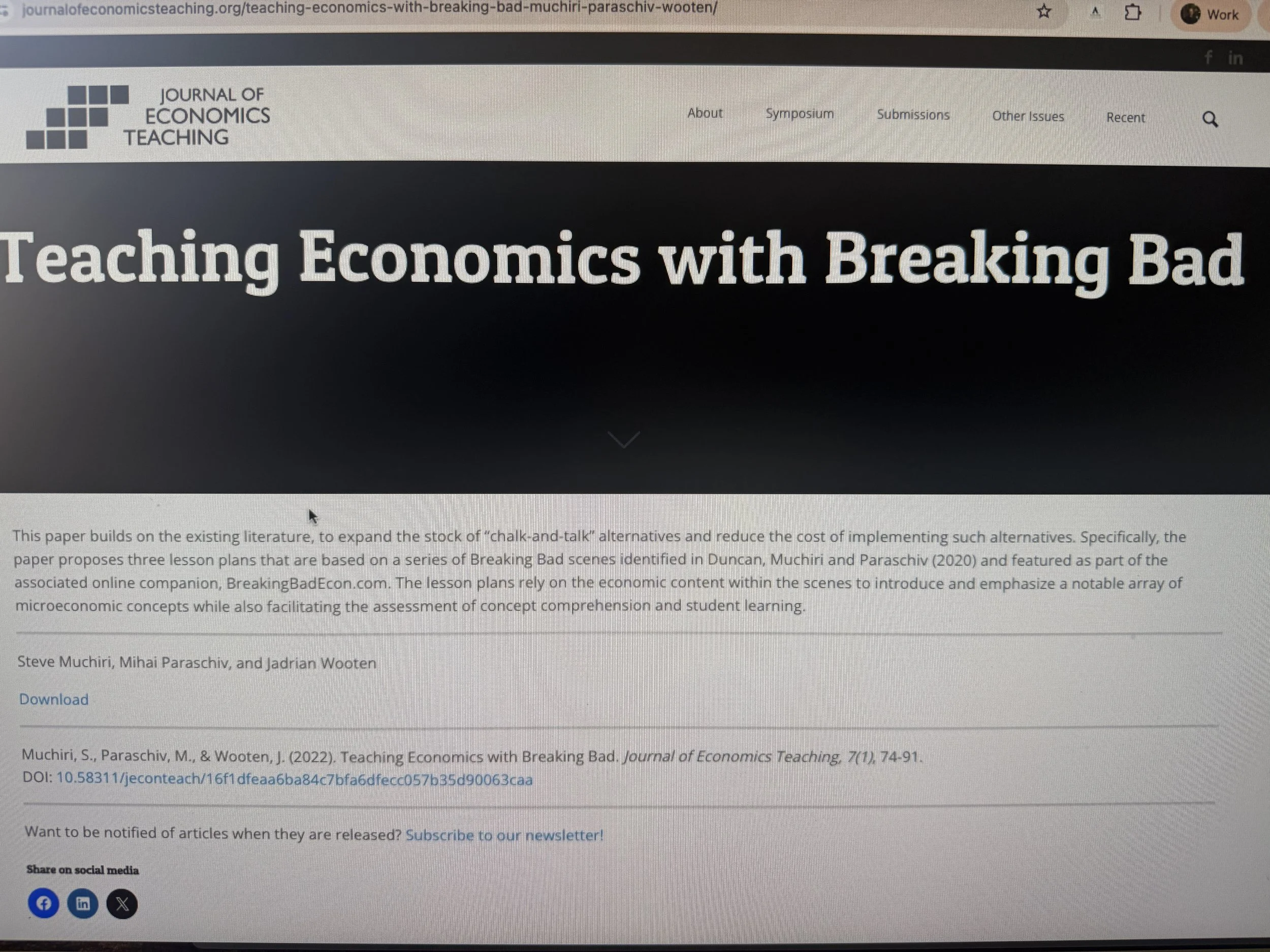
It got better. Dr. Wooten's research is about how to teach economics well. He wrote a book on the economics of Parks and Recreation, and he co-authored a paper called "Teaching Economics with Breaking Bad," with three lesson plans built on scenes from one of my favorite shows. I have a guess about which market they cover.
Then came the detail that impressed the counselor in me. He posts summary scores from his student evaluations on his own website. Sports Economics: 5.64 out of 6. Principles of Micro, the big intro course: 5.53 out of 6.
Professors do not usually publish their own report cards. I was ready to tell every student I work with to consider economics at Virginia Tech.
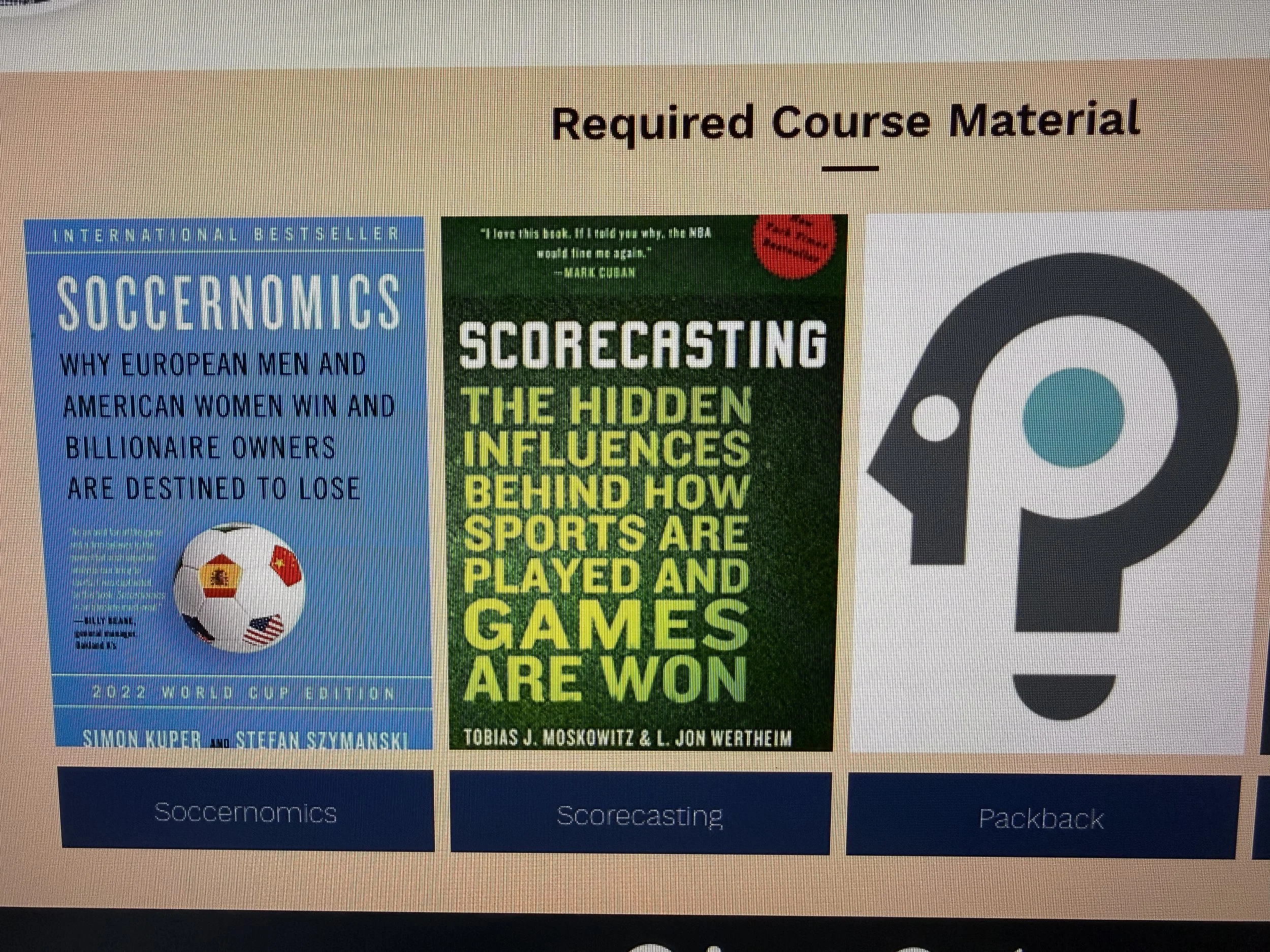
Soccernomics and Scorecasting, assigned reading for Virginia Tech's Sports Economics course.
One great professor is not a department
Then I told a colleague about my discovery. Her son is at Virginia Tech, and she had a different econ story. By her family's account, he took a class in the same department where more than 30% of the students either dropped or finished with a D or an F.
Same major. Same department. Very different semester.
So I did what I'd tell you to do. I asked Claude to research what's publicly known about teaching quality in the department and report back with sources. The report matched both stories. Dr. Wooten came up as a professor students go out of their way to take. Another came up as one students warn each other about.
I'm not naming the second one. One family's experience and a pile of online ratings are not a verdict, and a hard class is not automatically a bad one. Some of the best classes hurt a little. And my colleague’s son has had a great experience in the economics department, aside from this one professor.
But here's my read. A major is not one thing. It is a specific set of courses taught by specific people, and your student will meet both kinds. Better to know that in November than in sophomore year.
Your homework takes one evening
You can do this yourself tonight.
Pull up the actual course list for the major, not the brochure page. Pick three classes that sound interesting and find out who teaches them. Read those professors' own websites. Check whether the university publishes grade distributions, because many public universities do. Then hand the whole pile to an AI research tool, ask what students say about teaching in that department, and make it show its sources.
Treat what comes back as one input. Then ask about it on your next campus visit.
This is the part of my job I love. I started the week answering a question about a minor and ended it with a Breaking Bad paper in my downloads folder. Every rabbit hole makes me more useful to the next family.
The major on the application matters for getting into some schools. The people teaching it matter for the four years after.
Still deciding which major to list for Virginia Tech, or building a college list for next year? Schedule a free consultation. No obligation, no pressure.